Surgical forceps aren’t one instrument — they’re a whole family of tools, each shaped for a specific job: grasping tissue, clamping vessels, holding needles, moving sponges, or bowel clamping during intestinal surgery. Distributors and hospital buyers often search for “types of forceps” expecting a short list, but the real answer depends on what the forceps needs to hold and how much force is safe to apply. This guide breaks down every major surgical forceps type ASONS SURGICAL manufactures, what each one is actually used for, and how to tell them apart at a glance.
What Is a Surgical Forceps? Parts and How They Work
A surgical forceps is a hinged, scissor-like instrument used to grasp, hold or clamp tissue, vessels, instruments or materials during a procedure. Most forceps share the same basic parts: two shafts (also called blades or arms) joined at a pivot (the box lock), finger rings or grip handles at one end, and a working tip — jaws, teeth, rings or a serrated pattern — at the other. Many also have a ratchet lock built into the handle, which lets the surgeon lock the jaws closed hands-free once tissue is clamped. The tip design is what actually defines the forceps type: fine-toothed jaws for grasping tough tissue, smooth or fenestrated jaws for delicate structures, or a full ring for sponges and dressings.
Toothed vs. Non-Toothed Forceps
The first split buyers should understand is toothed versus non-toothed (atraumatic) jaws. Toothed forceps — like Kocher or Allis — interlock to grip firmly and are used where a secure hold matters more than tissue delicacy, such as heavier fascia or muscle. Non-toothed forceps — like Kelly or Babcock — spread pressure across a wider, smooth or fenestrated surface so they can hold delicate structures such as bowel, blood vessels or fallopian tube without crushing or tearing them. As a rule: if the tissue is tough and disposable (being removed or already clamped off), toothed is fine; if it’s delicate and staying in the body, non-toothed is safer.
| Forceps Type | Primary Use | Jaw Type |
|---|---|---|
| Allis Forceps | Grasping heavy tissue, fascia | Toothed |
| Artery (Hemostatic) Forceps | Clamping blood vessels | Serrated, non-toothed |
| Babcock Forceps | Atraumatic holding of bowel, tubes | Fenestrated, non-toothed |
| Kelly Forceps | General clamping | Serrated, non-toothed |
| Kocher Forceps | Firm grip on tougher tissue | Toothed tip |
| Mosquito Forceps | Fine, small-vessel work | Serrated, non-toothed |
| Needle Holder Forceps | Holding a suturing needle | Cross-hatched jaw |
| Sponge Holding Forceps | Moving gauze/dressings in the sterile field | Ring jaw |
| Towel Clamp Forceps | Securing surgical drapes | Sharp-pointed tips |
| Doyen Intestinal Forceps | Occluding bowel during intestinal surgery | Longitudinal serrations, non-crushing |
| Dissecting / Thumb Forceps | Precise tissue handling, suturing assistance | Plain or toothed tip |
Allis Forceps — For Grasping Tissue
Allis forceps have interlocking teeth built to hold heavy tissue without letting go, which is why they show up so often in general surgery and gynecology — grasping fascia, breast tissue or the edge of a hollow organ during resection. Because the teeth grip firmly, Allis forceps are reserved for tissue that is being excised or won’t stay in the body, not for delicate structures. See our Allis Tissue Forceps.
Artery (Hemostatic) Forceps — For Clamping Vessels
Also called hemostatic forceps, these clamp blood vessels shut to control bleeding during a procedure, and are one of the most-used instruments on any general surgery tray. Curved artery forceps uses center on reaching vessels at depth or around a curve of tissue — the angled jaw follows the tissue plane so the tip doesn’t have to be forced in straight. Straight artery forceps do the same clamping job but on vessels closer to the surface, where a direct approach works better. We manufacture both the curved and straight versions in surgical-grade stainless steel.
Babcock Forceps — For Atraumatic Holding
Babcock forceps have a wide, fenestrated (windowed) jaw designed to hold delicate structures like bowel or fallopian tube without crushing them — the opposite design philosophy from Allis forceps. See our Babcock Forceps.
Kelly and Kocher Forceps — For Clamping and Dissection
Kelly forceps are a general-purpose clamp used across almost every surgical specialty, with a smooth or lightly serrated jaw suited to routine vessel and tissue work. Kocher forceps look nearly identical but add teeth at the very tip, giving a firmer grip on tougher, fibrous tissue where a Kelly might slip. See our Kelly Forceps and Kocher Forceps.
Mosquito Forceps — For Fine Vessel Work
Smaller and finer than a standard artery forceps, mosquito forceps are used on small or delicate vessels — common in pediatric, plastic and microvascular procedures — where a bulkier clamp would crush surrounding tissue or simply not fit. See our Mosquito Forceps.
Needle Holder Forceps
Not technically for grasping tissue at all, needle holders hold a suturing needle steady so the surgeon can drive it through tissue with control on every stitch. The cross-hatched jaw pattern is designed to grip a rounded needle without it rotating or slipping mid-stitch. See our Needle Holder Forceps.
Sponge Holding Forceps and Towel Clamp Forceps
Sponge holding forceps uses come down to one job: moving gauze and dressings in and out of the sterile field without hands ever touching it directly, and packing or retrieving sponges from a body cavity during a procedure. The ring jaw holds the sponge securely without tearing it. Towel clamp forceps do a completely different job — their sharp, piercing tips grip and hold surgical drapes in place around the incision site, keeping the sterile field secure. See our Sponge Holding Forceps and Backhaus Towel Clamp Forceps.
Doyen Intestinal Forceps — For Bowel Clamping
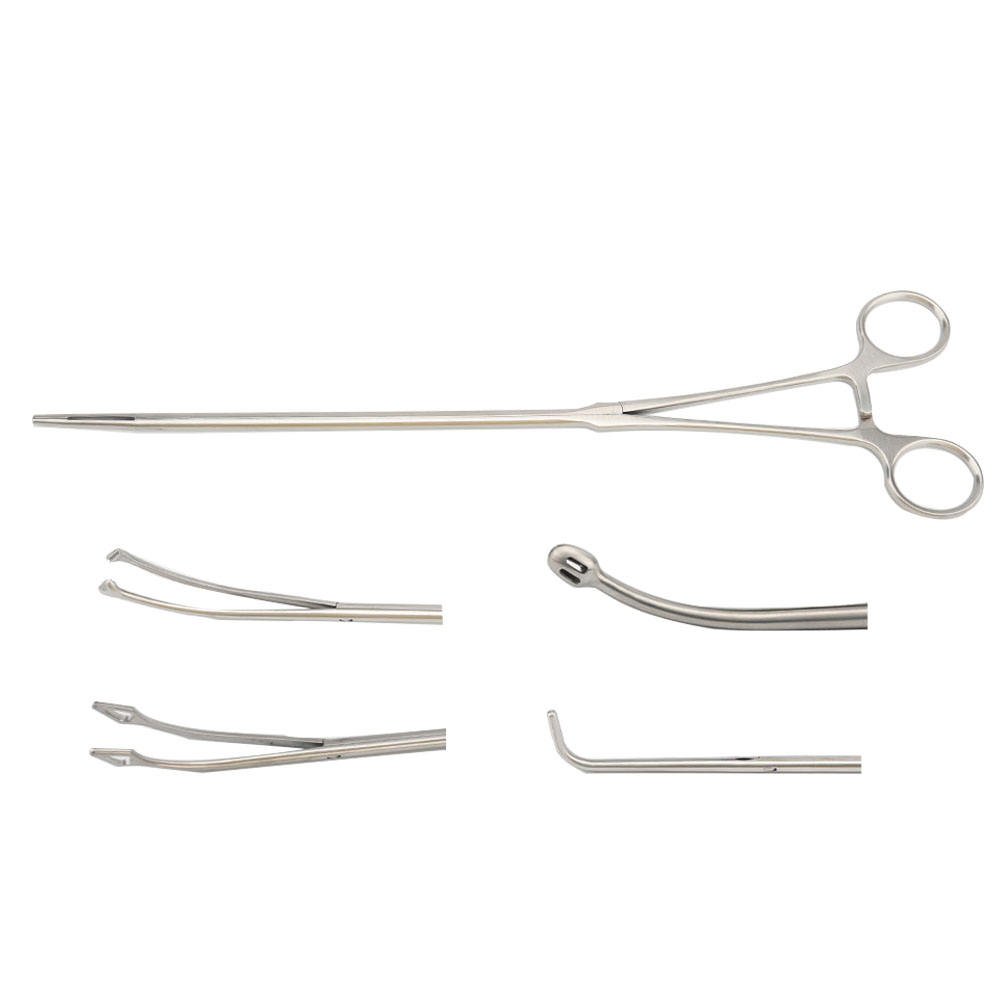
Doyen intestinal forceps are a longer, specialized clamp used specifically in bowel surgery to occlude a segment of intestine, controlling spillage of bowel contents while a resection or anastomosis is performed. The jaw uses longitudinal serrations rather than teeth or crushing ridges, which grips the bowel wall firmly enough to seal it off without damaging or perforating the tissue — a non-crushing clamp is essential here because bowel tissue is thin and easily injured. Doyen forceps come in straight and curved versions depending on the segment of bowel being clamped. See our Doyen Intestinal Forceps (Straight) and Doyen Intestinal Forceps (Curved).
Dissecting, Thumb and Tissue Forceps
“Thumb forceps” and “tissue forceps” are often used interchangeably, and for good reason — both describe the same handheld, non-locking, tweezer-style instrument held between thumb and fingers rather than through finger rings. These come in plain (smooth-tip, for delicate tissue) and toothed (for firmer grip on skin or fascia during suturing) versions. Dissecting forceps is simply the broader name for the same instrument family when used to separate tissue planes during dissection. See our Dissecting Forceps (Plain).
Frequently Asked Questions
What are the main types of surgical forceps?
The main categories are grasping forceps (Allis, Babcock), hemostatic/artery forceps for clamping vessels, dissecting/thumb forceps for tissue handling, needle holders, sponge and towel clamp forceps, and specialized clamps like Doyen intestinal forceps for bowel surgery.
What is the difference between thumb forceps and tissue forceps?
They’re generally the same instrument — a handheld, tweezer-style forceps held without finger rings. “Thumb forceps” describes how it’s held; “tissue forceps” describes what it’s used for.
What are curved artery forceps used for?
Curved artery forceps clamp blood vessels that sit at depth or around a curve of tissue, where the angled jaw follows the tissue plane better than a straight jaw would.
What are sponge holding forceps used for?
They hold and move surgical gauze or dressings within the sterile field, and are used to pack or retrieve sponges from a body cavity during a procedure.
Ordering Forceps from ASONS SURGICAL
All of these are manufactured in surgical-grade stainless steel at our Sialkot facility, with OEM and private label options for distributors ordering in volume. Browse the full General Surgical range or WhatsApp Us